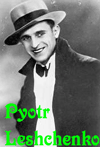
Pyotr Leshchenko
Barynya Entertainment
| Russian singers directory
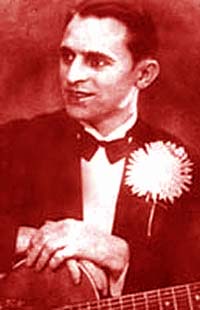 Russian singer Pyotr Leshchenko - "The King of Russian Tango" - was born on June 14, 1898 a citizen of the Russian Empire in village Isaeva.
His father was a clerk, mother - illiterate.
During the First World War, his mother and stepfather moved to Kishinev (now part of Moldavia) which was later annexed by Romania. As a result Leshchenko has been claimed as a national by Russia, Ukraine, Moldova and Romania. He sang almost exclusively in the Russian language.
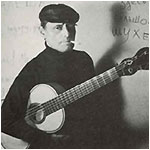
In his early childhood he sang in a church choir and learned how to play the guitar and the balalaika.
After the war Pyotr worked at various restaurants performing small theatrical acts, mostly dancing.
He had a soft baritone voice.
Russian singer Pyotr Leshchenko - "The King of Russian Tango" - was born on June 14, 1898 a citizen of the Russian Empire in village Isaeva.
His father was a clerk, mother - illiterate.
During the First World War, his mother and stepfather moved to Kishinev (now part of Moldavia) which was later annexed by Romania. As a result Leshchenko has been claimed as a national by Russia, Ukraine, Moldova and Romania. He sang almost exclusively in the Russian language.
In his early childhood he sang in a church choir and learned how to play the guitar and the balalaika.
After the war Pyotr worked at various restaurants performing small theatrical acts, mostly dancing.
He had a soft baritone voice.
After taking some ballet lessons in Paris, he started performing with his Latvian wife Zinaida, a dancer. Their act was a mixture of ballet, folklore dance and European tango, which was so popular it led to tours to Egypt, Persia, Turkey, Germany and Britain. It was at Riga, when he improvised gypsy and tango singing to make up for the absence of his pregnant wife, that he discovered he could sing in front of an audience. In 1935 he was at the peak of his success. Though he still included old Russian romances, and even Soviet songs (like Serdtse, the Argentine Tango song that would outlive him and which was originally sung by Leonid Utyosov in a different version as Kak mnogo devushek horoshih) in his repertoire, songs were now composed for him exclusively (with the tango songs turning Argentine in style and arrangement). One of his favourite non-Russian composers was Jerzy Petersburski, but he also sung work composed by Pavel German, Konstantin Podrevsky and Isaak Dunayevsky. Composers specifically composing certain songs for him were Oscar Strok, Mark Maryankovsky and Yefim Sklyarov. Many lyrics of Leshchenko songs were written by Boris Fomin.
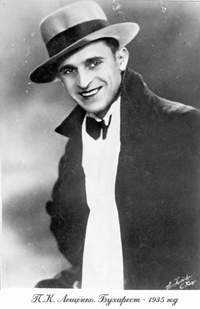
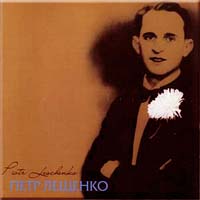
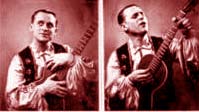
Pyotr Leshchenko photos
Pyotr Leshchenko MP3
In order to be able to download free MP3 files you may need to join Pyotr Leshchenko Club on Yahoo Groups first. Pyotr Leshchenko Club on Yahoo Groups have Music and songs of old Russia and Russian Emigres. It's spam-free group moderated by Mikhail Smirnov, director of New York based ensemble Barynya. Pyotr Leshchenko, Alyosha Dimitrievich, Zhenia Shevchenko, Gary Nova.
Pyotr Leshchenko - Chubchik.mp3
Pyotr Leshchenko - Fonariki.mp3
Pyotr Leshchenko - V Te Dni Pechali.mp3
Pyotr Leshchenko - Skazhite Pochemu.mp3
Pyotr Leshchenko - Vsyo Shto Bylo.mp3
Leshchenko performed for European nobles and "White" Russian emigres at his own "Leschenko" cabaret in Bucharest (dubbed the "Eastern Maxim"). The first part of every performance would typically be dedicated to gypsy music, but during the second part Leshchenko would dress up in a tuxedo, with a white silk handkerchief and sing and dance Argentine tango.
In the Soviet Union his work was banned both because he was believed to be a White emigre (which he was not legally) and because the style (tango and foxtrot) was deemed counter-revolutionary. Nevertheless, secretly he was very popular: people would even listen to Radio Tehran to hear his music, '78 plates were smuggled into the country from the Baltics, and specialists would bootleg his music onto "ribs" (used X-ray plates). When during the Second World War and the subsequent occupation of Odessa by the Romanian army, Leshchenko was finally able to perform in the country he still considered his own, people would queue for hours on end to buy a ticket to one of his Odessa concerts. It was at Odessa that Pyotr met his second wife, Vera Georgievna, for whom he would later, back in Romania, divorce Zinaida.
After Romania switched sides during World War II and the Soviet army came to Romania, Leshchenko was not arrested and became the protege of General Bulganin. Some sources believe this was due to Marshall Zhukov being a secret admirer of his music - Pyotr probably thought so, and after the War, wrote many letters to friends in the Soviet Union asking them to contact high-level officials so that he and Vera may be allowed back to the country of their birth.
In 1951, a week after receiving an official letter granting them permission to settle in the Soviet Union, Vera and Pyotr were arrested by the Romanian police. Vera was extradited to the Soviet Union (where she was condemned to penal labour for amongst other things, "marrying a foreigner") and Pyotr was sent to a Romanian prison near Bucharest. Both outlived Stalin, but Pyotr died in a prison hospital on July 16, 1954, without Vera (who had already been released but did not know her husband was still alive) at his side. Some friends present when he died claimed his last words were "Friends, I am happy, for I will return to my fatherland! I am going away, but I leave you my heart." (In the Russian original, "serdtse" is not the final word, however).
Pyotr Leshchenko Club
The Peter Lescenko Club, organized in 1991, is named after the most famous singer of the Russian Diaspora and father of the Russian tango Peter Konstantinovich Leschenko (or, according to the standard spelling of the time—Lescenko). The great bass Fedor Chaliapine called Lescenco a “record singer,” as his records sold millions of copies throughout the world.
The organizer and leader of the club is Alexander Petrov. The club promotes the music of Old Russia that is our heritage. It organizes concerts, radio shows, as well as Festivals of the Songs of the Russian Diaspora. The club’s concerts were televised in the 1990’s, but with the commercialization of television, such concerts are no longer aired. The Club has practically... read more
Music and Song of Old Russia and the Russian Diaspora
Music and Song of Old Russia and the Russian Diaspora. Legends of Russian immigration: Pyotr Lescenko, Russian Gypsy chanson performer Alyosha Dimitrievich, Russian Gypsy singer Zhenya Shevchenko, singer Gari Nova and Russian balalaika band "The Balalaika Russe", Bibs Ekkel and his group "Tziganka", singer Nikolai Massenkoff and other performers of Russian and Gypsy music ourside of Russia... read more
ССЫЛКИ ПО ТЕМЕ:
Music and Song of Old Russia and the Russian Diaspora
Музыка и песни старой России и русского зарубежья
Russian singer Pyotr Leshchenko
"Король Танго" певец Петр Лещенко
Pyotr Leshchenko Club
Клуб имени Петра Лещенко
Russian Gypsy chanson performer Alyosha Dimitrievich
Russian Gypsy singer Zhenya Shevchenko
musician, composer and linguist Bibs Ekkel
Russian folk singer Nikolai Massenkoff
Singer Gary Nova and balalaika band "The Balalaika Russe"
RUSSIAN GYPSY MUSIC DANCE
Russian entertainment database
Russian music, dance and song ensemble "Barynya"
contact
RELATED LINKS
Barynya Russian Event Planners

NYC, NY, NJ, PA, CT, and other states
|
Russian Food Catering Services

New York City, New York, NJ, CT, PA |
Апитерапия, лечение пчелами

Monmouth County Нью-Джерси
|
![]() Ded Moroz and Snegurochka Ded Moroz and Snegurochka
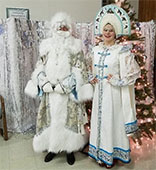
NYC, Brooklyn, New York, NJ
|

| |
Veronika - Russian singer, mezzo-soprano from New York. video
|
| |
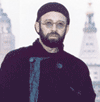
Acclaimed Russian Jewish singer and actor from New York Yakov Yavno
|

| |
Piques Dames perform in the New York metropolitan area. Their repertoire includes a variety of Slavic and European Classical and Folk vocal music as well as compositions from operatic and sacred classics.
|
| |
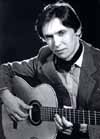
Russian, Gypsy, Jewish, Italian and American singer Sergei Pobedinski from New York City, USA
|
| |
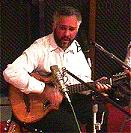
Classical Russian Gypsy singer Vasily Yankovich was named the best Tsygansky (Russian Roma Gypsy) singer in the United States. Available in New York, New Jersey and internationally.
|
| |
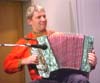
Russian folk singer and garmoshka player Mikhail Smirnov from Fort Lee, New Jersey performs authentic Russian folk songs and tongue twisters.
|

| |
Olyia - singer, songwriter from New York City.
|
| |
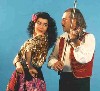
Danchenko Duo - Russian Gypsy voilin show from Brooklyn, New York.
|

| |
Roman Bodrov - Russian singer, musician, composer from Sergiev Posad, Russia.
|
| |
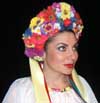
Russian, Cossack, Ukrainian and Gypsy folk singer Victoria Pichurova
from Brooklyn, New York, USA
|
| |
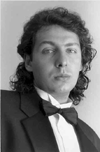
Russian singer, Bass-baritone Alexander Prokhorov from Boston, Massachusetts was born in Russia. Now he lives in Boston, where he is engaged as one of the performing artists with Boston University's Opera Institute. Alexander has been described as a "true deep bass with tones, that immediately astonished with their midnight-dark, chasm depth of richness and powerful timber..."
|
| |
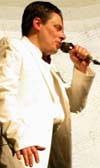
Russian singer (bass-barytone) Boris Kletinich from Montreal, Canada was graduated from the University of Theater Art and Film of Moscow (Russia). During his military service, he was soloist of the Air Force Orchestra and Chorus of the Red Army. Boris can sing different musical forms: Russian popular and love songs, rock and love ballad, the jazz, the popular writings of Broadway, the Jewish and Latin America songs, arias of opera.
|
| |
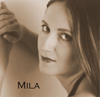
Mila - Russian Gypsy singer-songwriter from NYC.
|
| |
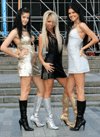
Twix - show group from Moscow, Russia.
|
|
Russian folk music free mp3 download
RUSSIAN FOLK SONGS LYRICS
Katyusha, Kalinka, Dark Eyes, Polyushko, Gari-Gari, Moscow Nights
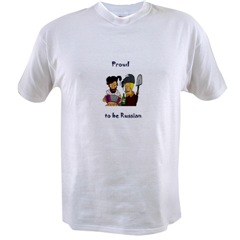
"Proud to be Russian!" 10$ dollars T-shirt
|